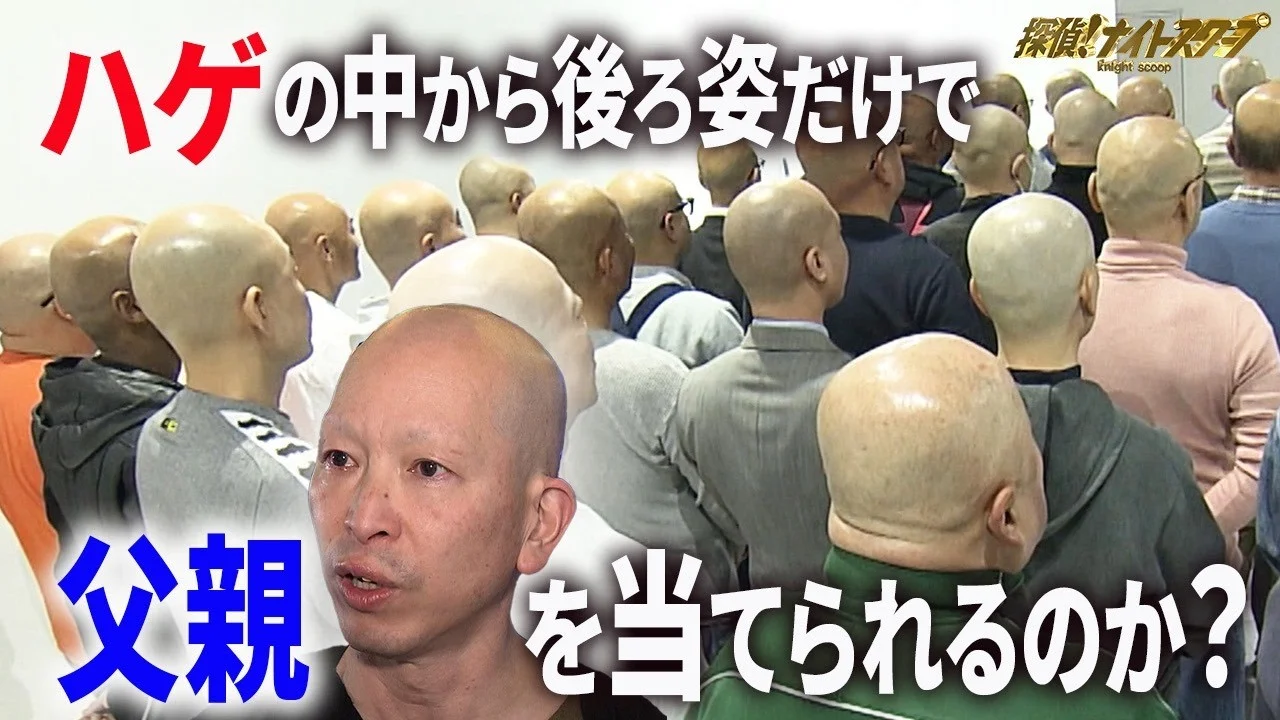
What's going on
A 26-year-old woman in Tokyo had a strange and unsettling dream: she was surrounded on all sides by bald men, their faces hidden, only the backs of their heads visible — and somewhere among them was her father. But no matter how hard she looked, she couldn't find him.
The dream stayed with her. She's close with her family, regularly making the trip back home to drink with her dad. So the possibility that she might not be able to pick him out of a crowd was quietly, unexpectedly frightening. She sent a request to Detective! Knight Scoop — a long-running Osaka variety show in which comedian "detectives" investigate unusual and surprisingly heartfelt requests from the public — asking them to put it to the test.
The production team was delighted. They recruited dozens of bald volunteers, dressed them in matching black hooded capes, and seated them on a merry-go-round at a marine aquarium. Blindfolded, the daughter reached out to feel each bald head as it slowly revolved past her, searching by touch alone for the specific texture and warmth of her father's scalp. What followed was, inexplicably, moving.
Comments
My take
Comments loosely translated for tone. Reactions collected from Togetter and X threads.
View original thread →

ハグ / ハゲ: In Japanese, hug (ハグ) and bald (ハゲ) are visually nearly identical in katakana. After ten minutes of reading exclusively about bald heads, the mishap is entirely understandable.
神回 / 髪回: Kamikai (神回) means “legendary episode” — literally “divine episode.” Kamikai (髪回) is an exact homophone meaning “hair episode.” Both apply simultaneously here, and that’s the joke.
ハゲしく / 毛が / ハゲます: A chain of bald-head puns. ハゲしく sounds like 激しく (greatly/severely) — “bald-ly regretful.” ケガ (injury) sounds like 毛が (hair exists). And ハゲます sounds like 励ます (to encourage) — “bald-ster her spirits.” All three land perfectly in context.