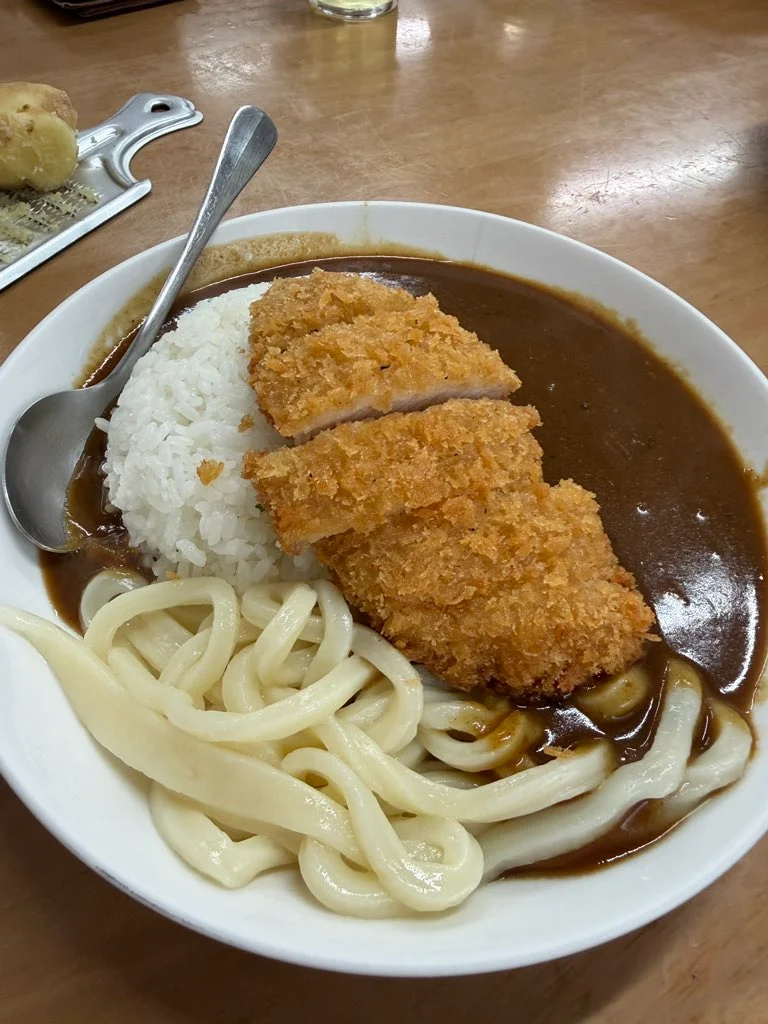
What's going on
Kagawa Prefecture, on the island of Shikoku, has built its entire identity around one dish: sanuki udon, the region's famously chewy, springy wheat noodles. The local devotion runs deep enough that Kagawa is half-jokingly nicknamed "Udon Prefecture." So when a traveler visiting from Hyogo spotted a menu item plainly labeled "Katsu Curry Sanuki Udon," he assumed it meant curry udon with a pork cutlet on top — a fairly ordinary combo, nothing to write home about.
What actually arrived took the name completely at face value. Not curry-flavored udon with a cutlet, but a full katsu curry rice set — rice, curry, breaded pork cutlet — served together with a separate helping of sanuki udon on the side. Two carb-heavy meals, stacked into one, exactly as advertised. The kind of dish that only makes sense somewhere that treats an extra bowl of noodles as a bonus rather than a decision that needs justifying.
Comments
My take
Comments loosely translated for tone. Reactions collected from Togetter and X threads.
View original thread →



@eiitirou · View on X
@eiitirou · View on X
The joke here is about word order in Japanese. Swapping which dish’s name comes first changes the implied emphasis, and apparently “Sanuki Udon Katsu Curry” reads as putting curry on a pedestal of udon in a way that sounds almost insulting to the udon — hence the safer, reordered name.
@eiitirou · View on X
@eiitirou · View on X
This is a pun: 悲願成就 (higan-jouju) is a set phrase meaning “a long-held wish finally comes true.” Here, the first character (悲, “grief”) is swapped for a character that sounds almost identical, 鯛 (tai, “sea bream”) — a nod to all the sea bream swimming in the castle’s seawater moat.
@eiitirou · View on X